
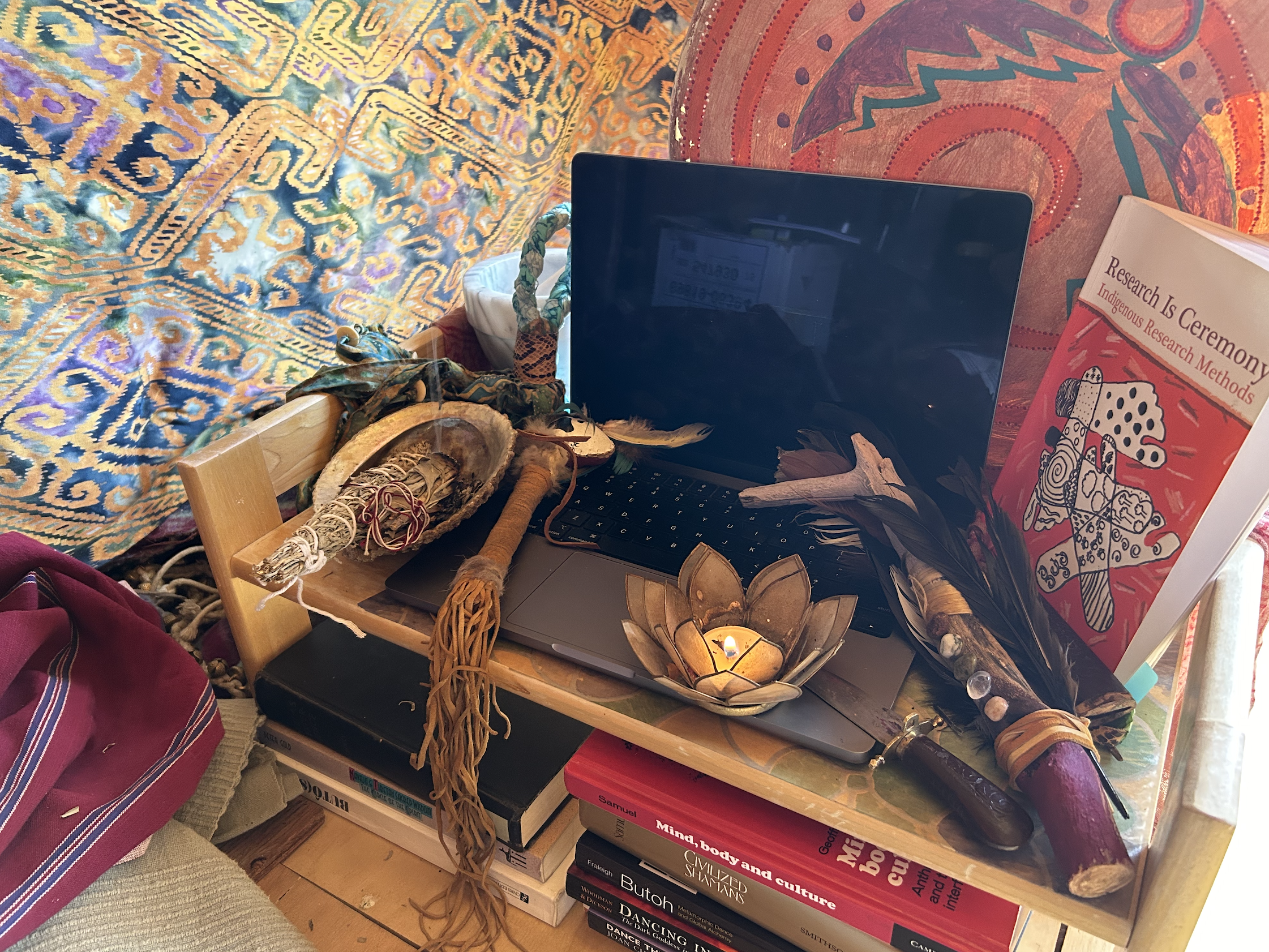

Modern academic research is based on an Indo-European colonialist “gaze” that presumes the inherent superiority of Western European values, inevitably overlaying those invisible epistemologies on the Indigenous cultures being “studied”. In his book, Research as Ceremony: Indigenous Research Methods (2008) Wilson challenges this fundamental approach to research, especially when the researcher or the object of research is Indigenous, by proposing an “Indigenous Research Paradigm” based on the Indigenous value of relationality, as well as bringing into consideration the ontology, epistemology, axiology and methodology from within the living value systems of Indigenous peoples.
What is “relationality”?
According to Wilson,
“An Indigenous paradigm comes from the foundational belief that knowledge is relational. Knowledge is shared with all of creation. It is not just interpersonal relationships, not just with the research subjects I may be working with, but it is a relationship with all of creation. It is with the cosmos, it is with the animals, with the plants, with the earth that we share this knowledge. It goes beyond this idea of individual knowledge to the concept of relational knowledge. Who cares about these ontologies? It’s not the realities in and of themselves that are important; it is the relationship that I share with reality.” (73-74)
Wilson’s approach simultaneously challenges and invites academic researchers to engage in an Indigenous research paradigm by stepping into relationality as a fundamental element of the research process. He argues that all research is inherently biased by the personal values of the researcher themselves, and paradoxically the more a researcher distances themselves from their subject, the less the subject is fully and accurately understood. Traditional research methods value so-called “objectivity” where the researcher must distance themselves from the object of their research: once objectified the researcher does not allow personal bias to interfere with the pure science of research. On the other hand, a researcher employing an Indigenous research methodology acknowledges from the start that their mere presence within an Indigenous context alters the very nature of the reality they are observing. Here we are moving from the Cartesian dualism of Newtonian physics into the fascinating and complex world of quantum relativity where the observer is inherently and inextricably integrated with the observed outcome.

Respect, Reciprocity, and Responsibility
Wilson encourages researchers to engage this dynamic respectfully: we are not seeking to become Indigenous (read appropriate indigenous values), rather we celebrate the curiosity that brought us – as academics in a Western European educational system – to engage with a particular cultural context, and seek to understand it from within its own value systems. Only then do we, as researchers, move from appropriation to appreciation, from objectivity to relationality.
Indeed, an Indigenous methodology may be more truly “objective” than “objectivism”. Based on an axiology “built upon the concept of relational accountability…value judgements loose their meaning.” Instead, “the knowledge that the researcher interprets must be respectful of and help to build the relationships that have been established through the process of finding out information.” (77)
Call to Action
Institutions of higher education must urgently seek to implement Indigenous research methodologies across all disciplines. The immediate importance of bringing Indigenous research methodologies to modern academic institutions is two-fold: first, we begin to undermine centuries of academic “objectification” that has become the justification for the violent colonization of indigenous cultures. As a result, the indigenous wisdom that has allowed ancient civilizations to evolve in harmony with the environment has been lost, and our modern Western civilization is headed full-speed toward irrevocable destruction of the natural world of which we are a part and on which we depend, viz, relationality. We deny relationality at our own peril.
Second, as academics we have a responsibility to re-examine existing research from an Indigenous perspective that was likely not included when the research was originally conducted. Such historical research that was considered objectively solid, and yet led to some unintended, disastrous consequences, or a thesis that is fraught with irreconcilable conclusions could be made whole by inviting Indigenous epistemology. The “objective” researcher distances themselves from the consequences of their research, but within the Indigenous value system of relationality, the researcher is just as responsible for the outcome as they are for the process of research itself. By adopting Indigenous research methodologies at the institutional level, we may begin to look back and take responsibility for the error of our arrogance in asserting the indelible superiority of objectivism. As Indigenous research methodologies are not currently well understood in academic settings, it takes a great deal of effort to justify their use before engaging in any serious inquiry regarding the actual topic at hand. Wilson’s advocacy for Indigenous research methodologies advances the discourse across academic disciplines, making headway for the next generation of researchers from all backgrounds to engage in a more relational approach to broadening our shared knowledge.

No matter our cultural heritage, genetic ancestry, or current social context, we are all indigenous to this Earth, and to each other. Honoring the relationships that create our shared reality, and those connections that become the lived experience of our shared humanity, begins the imperative work of reclaiming our inherent dignity, resolving the existential dilemma of belonging, and enacting our responsibility to all of creation.
One response to “Reimagining Research: Embracing Indigenous Methodologies”
thank you for sharing what is important to you- very good to know your still active
i miss being in touch with you -are you still in boulder?- I have a new book out UNCERTAIN TIMES- Carl@wildernessmedicine.com
hi Carl! Wow, how neat to see your comment. Thanks for reading. I’ll send you an email 😊