
I was recently asked to offer a talk at BLISS: Sacred Sound and Chant Festival happening August 9-11 in Longmont, Colorado.
While there are many topics that interest me, and many more that I would love to explore, there are very, very few topics on which I would consider myself expert enough to offer a talk. The organizer explained she was interested in the origin, forms, meaning and implications of whatever topic I chose.
As I am sitting with this assignment, and piles of books at my disposal preparing for a research proposal to eventually learn much much more about the many topics that interest me….I am struck by the silence of my curiosity. Then I head to the event website to peruse the schedule:
every.
single.
moment.
is FULL
of sound.
….of course, it’s the “Colorado Sacred Sound and Chant festival”.
But knowing me, as I love to turn things on their head, I wonder to myself, well, what is the origin, form, meaning, and implication of silence? How do we access the silence from which all sound originates? This is something that I could speak to, and listen to, and perhaps pique my audience’s curiosity with – what does it mean to sound silence?
1. Simon & Garfunkle
I’ve come to talk with you again
Because a vision softly creeping
Left its seeds while I was sleeping
And the vision that was planted in my brain
Still remains
Within the sound of silence
In restless dreams, I walked alone
Narrow streets of cobblestone
‘Neath the halo of a street lamp
I turned my collar to the cold and damp
When my eyes were stabbed by the flash of a neon light
That split the night
And touched the sound of silence
And in the naked light, I saw
Ten thousand people, maybe more
People talking without speaking
People hearing without listening
People writing songs that voices never shared
And no one dared
Disturb the sound of silence
“Fools” said I, “You do not know
Silence like a cancer grows
Hear my words that I might teach you
Take my arms that I might reach you”
But my words, like silent raindrops fell
And echoed in the wells of silence
And the people bowed and prayed
To the neon god they made
And the sign flashed out its warning
In the words that it was forming
Then the sign said, “The words on the prophets are written on the subway walls
In tenement halls”
And whispered in the sound of silence
This classic song is, in the end, a story about the power of the unsounded truth. While the poet is crying his words in the darkness of the night, and preaching his visions of truth to the masses, his words, “like silent raindrops fell, and echoed in the wells of silence.” In the end, silence itself is the teacher as the “subway walls” and “tenement halls” speak volumes to the truth that has always been self evident, and yet we didn’t have the psychological, emotional, kinesthetic space to bear witness.
2. Georgia O’Keeffe

“Because objects of art are expressive, they are a language [unto themselves]. Rather they are many languages. For each art has its own medium and that medium is especially fitted for one kind of communication. Each medium says something that cannot be uttered as well or as completely in any other tongue.” – pg 106, Art As Experience by John Dewey
Dewey continues in the same paragraph to explain how the daily practicality of verbal expression within a commonly understood language has given prevalence, if not sheer primacy to verbal, linguistic interpretations of reality. AND YET, what is lost in translation? The hidden, unique language of the art itself – the “sound” as it were, of silence.
How do we begin to recover these lost languages? The language of painting and sculpture? Of nature and dreaming? By listening. “Language exists,” Dewey reminds us, “only when it is listened to as well as spoken. The hearer is an indispensable partner.” Between the object (sound) and subject (listener) we have the predicate of active perception, the meeting of phenomena and perceiver in which reality actually occurs. Dewey calls this predicate the “connector” without which both subject and object have no meaning. It would be like saying “I you.” Without the predicate of “love” we have no meaning, no connection. But add the relationship, the active engagement, the raison d’etre, “love” and we have a complete sentence. I wonder, what can we discover in the linguistic space between sounds and concepts, when we allow that space to relax, and open just a little?
3. MU: the sound of silence
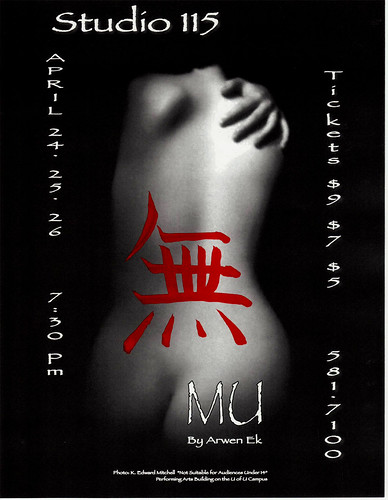
MU is a term that I learned from my Japanese teachers, in Zen Buddhism, Japanese martial arts, and Japanese theater. It is an indispensable aesthetic principle that is deeply embedded in the arts as well as the Japanese psyche. Generally speaking, MU is a nonsense word, or it means “nothing” or “emptiness” depending on the context.
There is a famous Zen Buddhist koan where the student asks the Master, “Does a dog have Buddha nature.” to which the Master simply replies, “MU.” Please don’t try to “get it” – the real purpose of koans is to shock your intellectual mind out of thinking so that for just a moment, you might taste the spaciousness, the awe, and the wide open silence of enlightenment. The most appropriate response for a student of Zen Buddhism is spontaneous, uncontrived, and free from constraints of logic and reason. One might well burst into laughter, or do a crazy dance, or sing a doha or song of spontaneous realization.
Yes, that is exactly what I’m getting at. There is no “sacred sound” without “sacred silence”. AND, “sacred silence” is not always what we think it is. Do you know silence? Please tell me what you think silence is, I am so curious to hear! If you can’t tell already, I am fairly opinionated on this topic. Would you be willing to consider the idea that “silence” is not necessarily the state of “zero decibels”? Is silence the absence of sound, and if so, is sound the collapsing of the infinite potentiality of silence into a single, reified vibration?
Let’s try one more koan: “If a tree falls in a forest, and there is no one there to hear it, would it make a sound?” This riddle begs the question, what is the nature of sound? According to John Dewey (as we read above from Art As Experience) phenomenal reality exists ONLY in dynamic relationship: the object (the falling tree), the subject (the perceiver of the falling tree), and the predicate (the air wave vibrations that constitute the sound traveling from the source of the sound to the perceiver, the individual consciousness who is experiencing the sound). In this case, the answer would be “no” because for the reality of “sound” to be complete, we must consider the source and destination. Without the presence of a “listener” there is no such phenomena that can be called sound.
But let’s go one step deeper: who is this “listener” anyway?

The “listener” is not my ear, or the ear canal or eardrum, or the eustachian tube, nor is it the vestibular or auditory nerves, or the auditory cortex. This is demonstrated by scientific studies observing the “cross-modal plasticity” of deaf individuals where the auditory cortex is indeed activated when communicating via sign language. In other words, “deaf” people “hear” sign language. It is also a well-known phenomena that sensory limitation in one area heightens sensitivity in others. For example, remember this viral performance of a deaf woman who re-taught herself to sing?
Now that we’ve completely, thoroughly deconstructed the nature of sound, and the non-specificity of the listener, we may very well conclude that sound and silence, can only be said to exist in Dewey’s dynamic relationality. Does this change your opinion of silence? Does it transform your experience of silence?
Rather than a state of “sensorial deprivation”, what if “silence” hovered in the ethereal state between the vibration of my vocal cords and corresponding vibration in your ears?
Could it be possible to actually hear silence,
suspended
in the space
between
words?
4. Hildegard of Bingen
When I was a Buddhist nun, I learned that my whole life could be saturated with sacredness if I brought my awareness and intention to everyday actions. Silent meditation became the bookends to hours of sacred chanting, prayer, song, and movement. Sacred sound emerged from, and returned to sacred silence.
Silence is made sacred by the simple act of our bringing our attention and intention to it. What happens when we open all our senses to silence? Is it possible to listen so deeply that we can actually hear the sound of silence?
Silence is alive, it is dancing vibration that simply hasn’t landed on a note. It is open potentiality, in the moment before a “sound” can be recognized and interpreted, it is pure perception, unmediated awareness, MU.
From this place of deep listening, free from grasping and expectation, perhaps now I understand a little of the mystical experience described by the 12th century Benedictine visionary Hildegard of Bingen:
