
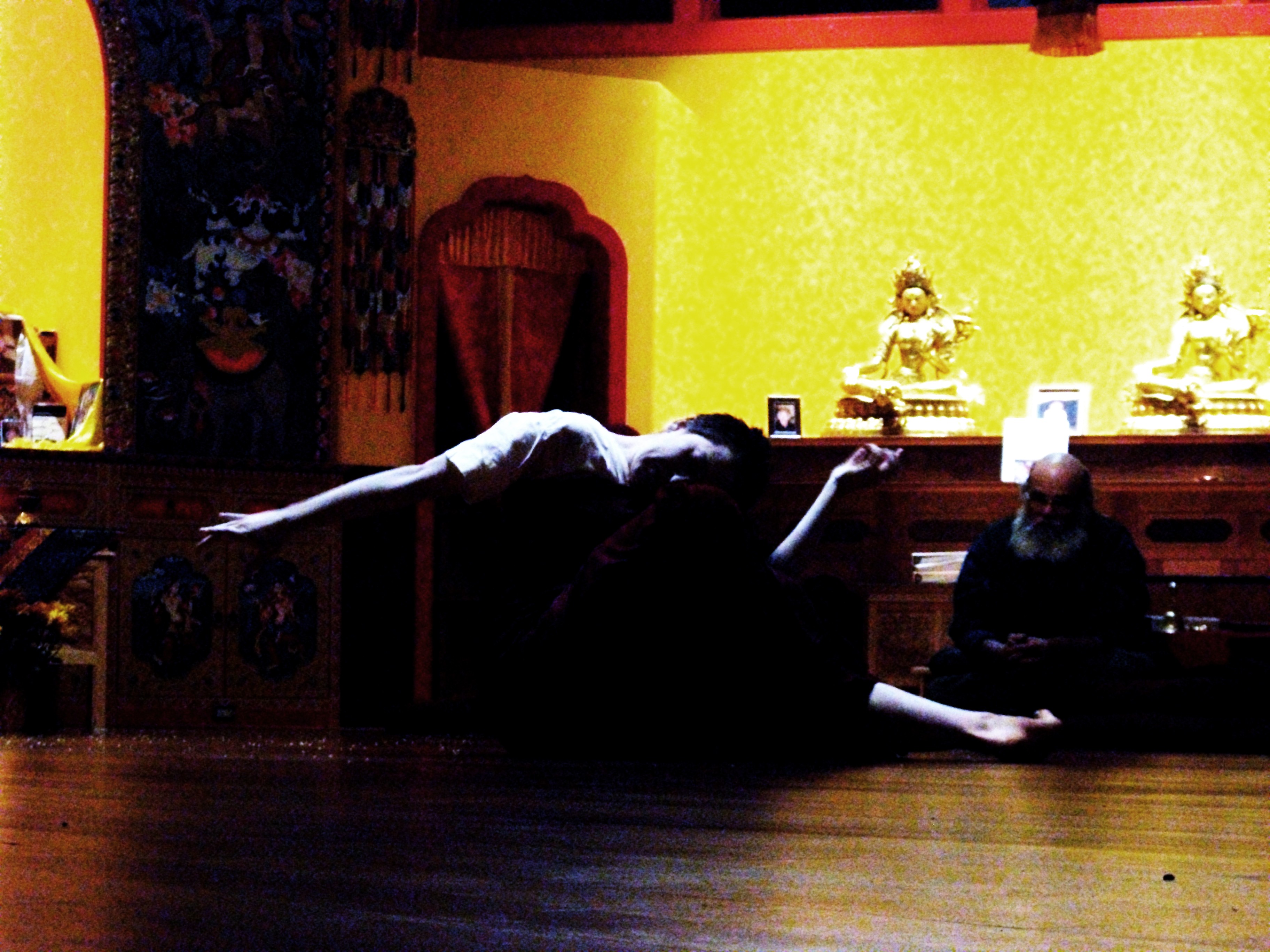
To modern Western culture, the dancing nun is a contradiction in terms, or a merely laughable moment that peaks on social media for a while, and is just as soon forgotten. But I would argue the import of the dancing nun is far more profound.
“It’s not done as a gimmick…it was purposely done as a prayer.” – Nun at Dublin nunnery.
Honestly….how can you NOT be smiling, and laughing yourself to tears when you watch this. Their purpose was to bring “joy and light to the world” during the pandemic – mission accomplished, sisters.
This kind of ecstatic dance is overflowing with goodwill, abandonment of the self, freedom and joy – the tip of the iceberg, the first step on the path to meeting – and embodying – the divine through movement.
If this satisfies your longing for embodied wisdom, stop reading now. Re-watch the wonderful video of the dancing Catholic nuns, dance along with them, and go to bed drunk on the illusion of your own eternal happiness – oops, I let myself get a little cynical there, non?
However….if you’re ready to dive in deep with me, watch this:
I remember watching the full version of this dance years ago on YouTube…easily over 30 minutes of raw footage of this dancer moving through all the waves and transformations of divine inspiration as her body is moved by the sacred wind of the Beloved.
While perhaps this dancer does not fit the Roman Catholic definition of “nun” there is no doubt she has just as much devotion and commitment to God as any cloistered monastic.
Regretfully, I can no longer find the link to the original full performance – please, if anyone reading this knows what I’m referring to, drop the link in the comments below! I was so deeply moved by the entire performance, I couldn’t take my eyes off the dancer. Five minute fast cuts cannot convey the expressions of her face and body as she drinks in the divine, and allows it to overcome her being completely; how she surrenders every cell in her body to the dance, in complete, utter, perfect surrender.
“Come forward, do not stray in unbelief,” says Rumi, “come dancing to divine knowledge … and come, return to the root of the root of your own self.”
https://danceofoneness.org/dancing-the-divine/
Sacred Dance
…has it’s origins here, in the utter surrender of the body to the Beloved, to allowing the energy, the shakti, the chi of the Divine to flow through our cells, our bones and marrow, and spill out through our pores as we dance. Sufi traditions that include sacred dance as a vital part of the path culminate religious ceremony with the ritual of whirling. The whirling itself, as I understand secondhand, has four stages, or “salams”:
- recognizing the Divine origin of the entire universe
- the holiness of all creation
- the annihilation of the self
- to serve the Beloved in the world
In the fourth, and final stage, the dancer receives divine love through the right hand stretched upward, and gives unconditional love to the whole world through the left hand stretched down toward the earth. She is an empty conduit, a vessel, for the energy of the Divine.
Rushen
Korde Rushen is a secret and highly advanced Tantric Buddhist practice that involves not just the body through movement, but also the speech as well as the heart mind. All three aspects of the human being are activated in Rushen practices to exhaust every last ounce of resistance that the human ego can manufacture in the face of its utter annihilation.
All I can say for the moment, from direct experience, is that in the last moment, at the threshold of annihilation, when that last drop of resistance evaporates – the sensation of jumping off a cliff, and being burned alive in the great unknown of the dance emerges as spontaneous, uncontrived and transcendent awareness, song, and dance.

For the main part, the outer and inner Khordé Rushen (separating the domains of saṃsāra and nirvāṇa) and the stages of purification related to the three doors must be practised precisely. For the purification of mind, by investigating mind’s emergence, presence and departure as part of a thorough analysis of the basis and origin of mind, we determine that external objects of perception lack foundation or source. We also come to understand that our own internal aggregates, elements and sense-sources, our capacity for vocal expression based on speech and the circulation of breath, and the secret flickering movements of the mind are all without underlying basis or origin and by nature beyond arising as well. When we search and do not find anything, we simply allow the three doors to rest and relax in the essence of that experience, without trying to modify or adjust it.
https://www.lotsawahouse.org/tibetan-masters/jamyang-khyentse-chokyi-lodro/brief-dzogchen-instruction
The pedagogy that has developed to access such states of liminal consciousness overlays with shamanic trance, endurance athletics, Yamabushi priests, Hindu ascetics, Sufi dancers, Tibetan yogis and Butoh dancers alike.
What is the universal praxis of transcendence and what are its origins? How is it accessed and what is the quantitative and qualitative impact of these practices and traditions – social relativity, personal development, and human evolution?
Butoh
Butoh began as a rebellion. Even Hijikata Tatsumi, the founder of Butoh, named one of his most famous choreographies “the revolt of the flesh“. The outer rebellion of Butoh is that of Japanese youth in the 1960’s against post-war sentimentality for “old Japan” as well as a rebellion against the rapid Westernization of Japanese culture. Certainly in this context, Butoh can be seen as arising out of a profound identity crisis for the entire Japanese race.
And yet, Butoh has a more enduring resonance that has allowed it to transcend cultural boundaries and bodies. The gestures and aesthetics of Butoh emerge from a deeper rebellion, the universal crisis of human identity. A personal examination of the human condition provokes an existential crisis (a la Kierkegaard) as we are individually and collectively confronted with the inevitability of pain, our impending mortality, and the impulse to discover (create, fabricate, or otherwise depending on your particular existential bend) a grand theory that gives meaning to it all.
Butoh may be – in its most essential reification – a form of existential sublimation, where the inescapable suffering of existence is “transform[ed] into a work of art.” And yet, in the process of creating such sublime and wretched art we unwittingly unravel the foundations of existence (a la Rushen), and stumble into the liminal domain of the Tibetan Yogis, the Yamabushi Mountain Priests, the Whirling Dervishes, Hindu ascetics, endurance athletes and Shamans alike.
Meet A Butoh Dancing Buddhist Nun
And now we have come full circle, back to this dancing nun, who has had more than a hunch about these overlapping praxes in the evolution of the human response to self-awareness and existential reality. All these things and more are what I will be exploring in my forthcoming thesis proposal, using “words, words, words” (to quote Hamlet) but also going to the source of these profound traditions where living links still exist and are accessible to the modern researcher – Japan, Tibet, India, Nepal, the Middle East, and Australia.
In the meantime, I invite you to savor the self-annihilation of one Buddhist Nun, who is peeling off the layers of her skin to reveal the flesh eating dakinis dancing in her marrow.
While perhaps this dancer does not fit the Roman Catholic definition of “nun” there is no doubt she has just as much devotion and commitment to God as any cloistered monastic.
I present to you “Threads of Ma” recorded live at Tara Mandala Buddhist Retreat Center in December 2010.
Post Script:
Regrettably, I did not have time or space here to wax poetic on Chod – another tradition of embodied practices that involves selfless self-annihilation and dancing with demons – a topic on which I have written elsewhere. More to come, stay tuned!
One response to “Viral Dancing Nuns”
[…] …and second most popular post is “Viral dancing nuns” […]